“Annunzio … Franciscum.”
On March 13, 2013, the world watched as white smoke gave way to an unexpected name. When Cardinal Jorge Mario Bergoglio stepped onto the loggia of St. Peter’s Basilica, everything had changed—his vestments, his role, even his name. The 265th Successor of Peter would now be known as Pope Francis.
Yet the surprise was not only his identity as the first Pope from the Americas. Something far more unprecedented had just occurred: for the first time in centuries, a reigning pope would serve while his predecessor still lived.
When the Church had Two Popes
Two Popes, One Church
As Pope Francis greeted the faithful to deafening cheers, Pope Emeritus Benedict XVI remained quietly at Castel Gandolfo, watching the moment unfold on television. What followed was as striking as the election itself.
Before speaking of himself, Francis turned the attention of the world toward his predecessor:
“First of all, I would like to say a prayer for our Pope Emeritus Benedict. Let us pray together for him, that the Lord may bless him and Mary may protect him. Our Father who art in Heaven…”
In that instant, a new and unexpected relationship began—one that would define a decade of life within the Vatican: two popes, one reigning and one retired.
An Unimaginable Reality
The sight of two living popes was, for many, almost inconceivable.
Delia Gallagher recalls the astonishment:
“How strange, how strange. I think we were all amazed. It was something that was completely outside of any intellectual possibility to see two living popes.”
Frank Rocca echoes the sense of history being rewritten:
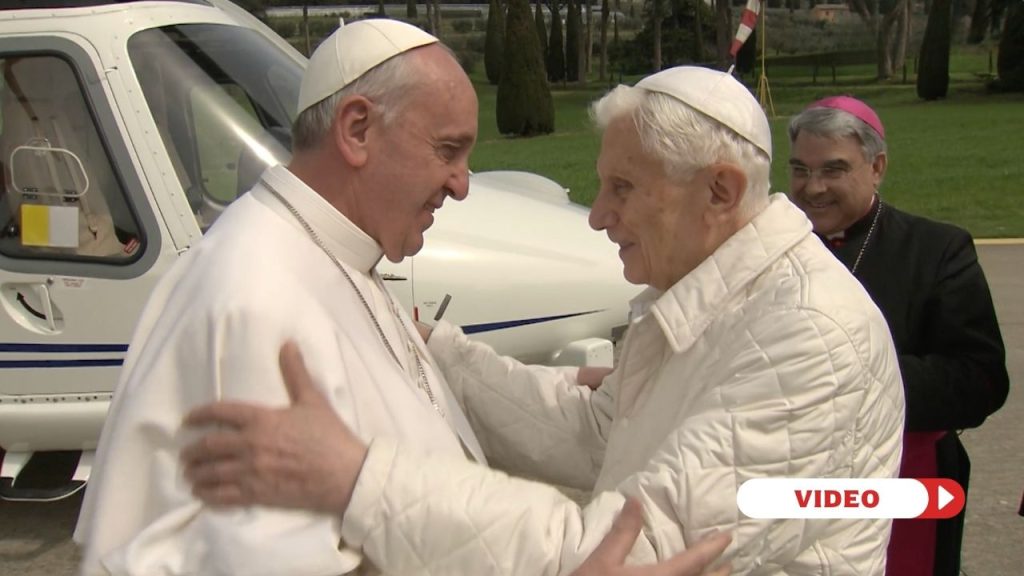
“Who has ever seen anything like that? Ever… there have been retired popes… but no image like that.”
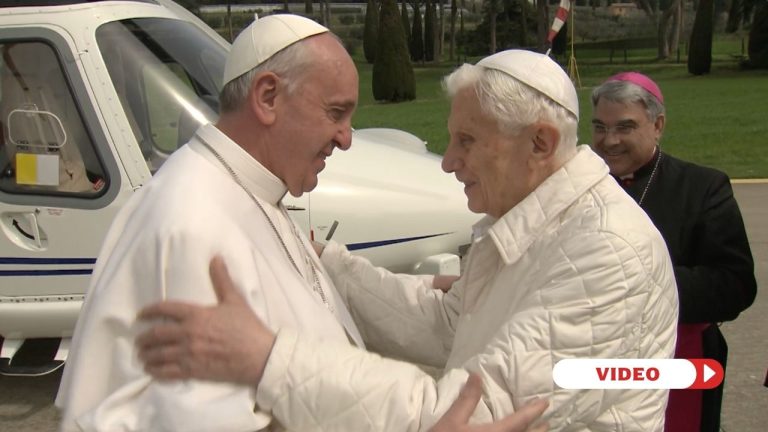
And yet, what could have been a moment of uncertainty quickly became something else: a visible sign of unity. Francis’ early visit to Benedict helped reassure the faithful that continuity, not division, would define this new chapter.
A Shared Prayer, A Shared Mission
Ten days after his election, Pope Francis traveled to Castel Gandolfo to meet Benedict XVI. At first, the encounter was marked by humility and deference—each inviting the other to take precedence.
In the end, they simply knelt side by side, sharing the same kneeler in prayer.
It was a quiet but powerful image: not two authorities in competition, but two servants united before God.
A Life of Hidden Support
Months later, Benedict XVI moved into the Mater Ecclesiae Monastery within the Vatican Gardens, only a short distance from Pope Francis’ residence at Santa Marta.
Rather than retreating from the Church, he chose to remain at its heart.
As Frank Rocca explains:
“He chose to stay in the Vatican… he said… that for me there will be no more going to conferences… I will live a life of retirement, of quiet, of isolation… of solitude.”
But this solitude was not abandonment. It was a form of service.
Delia Gallagher reflects:
“By staying there, I think it did show that he was not abandoning the Church… that he was staying, as he said, in prayer in support of the Church.”
Avoiding Division, Preserving Unity
Some feared that two popes might create confusion or even division. Yet Benedict’s decision to remain in the Vatican helped prevent precisely that.
“The choice of living in the Vatican was precisely to avoid that kind of thing,” Rocca notes.
Had he returned to Germany, Gallagher suggests, it might have created “a situation really of two papacies.” Instead, his quiet presence reinforced unity rather than undermining it.
A “Wise Grandfather” in the Vatican
Over time, what once seemed strange became familiar. Pope Francis himself described Benedict in deeply personal terms:
“I have said many times that it gives me great pleasure that he lives here in the Vatican, because it is like having a wise grandfather at home.”
The relationship was marked by mutual respect and affection. Francis even consulted Benedict on certain occasions, valuing his theological depth and experience.
Gallagher summarizes it simply:
“He felt he was a wise grandfather… and you couldn’t have any other idea from Pope Benedict. That’s really who he was.”
Benedict’s Quiet Strength
For his part, Benedict XVI expressed gratitude and peace in his new role:
“Your goodness… has continually impressed me and greatly sustains my interior life… My true home is your goodness. There, I feel safe.”
Freed from the burdens of the papacy, he lived a life of prayer, receiving occasional visitors, praying the rosary in the Vatican Gardens, and quietly accompanying the Church.
As one observer noted, this hidden life may have extended his years:
“If he had remained Pope… the pressure of that office… might have worn him out. But he was able to rest and have a great quiet life.”
Benedict’s resignation was not only an administrative act—it was deeply theological.
As Fr. Pablo Blanco Sarto explains:
“When a Pope… chooses to withdraw for prayer, it serves as a powerful example… His withdrawal… is also a gesture of support for the Pope who follows… This action exemplifies… the theology of holiness.”
In stepping back, Benedict did not diminish the papacy. He illuminated its spiritual core.
Throughout his pontificate, Pope Francis consistently acknowledged Benedict’s contributions—especially his efforts to confront the abuse crisis:
“His frank and decisive intervention continues to serve as a spur… to correct the errors of the past and to enact strict rules.”
Their relationship was not one of rivalry, but of continuity—each building upon the work of the other.
On December 31, 2022, Benedict XVI passed away at the age of 95, nearly ten years after his resignation. His final words were simple and deeply personal:
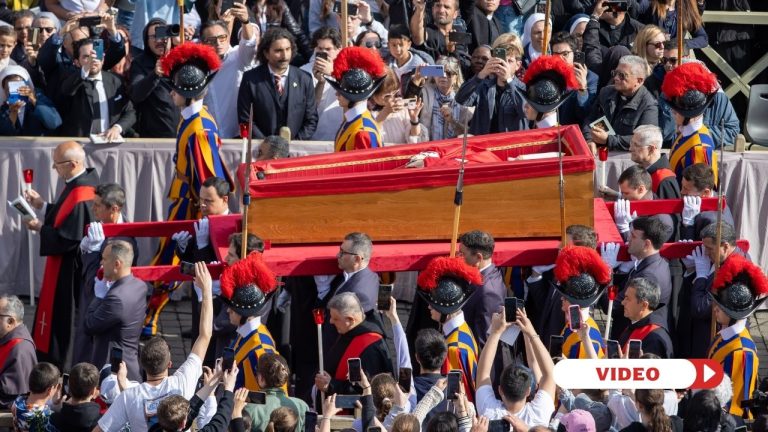
Days later, Pope Francis presided over his funeral, entrusting his predecessor to God with these final words:
“Benedict, faithful friend of the Bridegroom, may your joy be complete as you hear his voice, now and forever!”
An Unprecedented Chapter Closes
Benedict was laid to rest in the grottoes beneath St. Peter’s Basilica, among the long line of his predecessors.
With his passing, a unique chapter in Church history came to a close—a decade in which two popes lived side by side within the Vatican walls.
It was a moment that began in surprise, unfolded in humility, and ended in unity.
Two popes. One Church. And a shared witness that, even in unprecedented times, the heart of the Church remains communion.
Alan Holdren contributed to this article. Adapted by Jacob Stein.
Source: https://ewtnvatican.com/articles/when-the-church-had-two-popes