“I arrived here decades ago, and at the beginning, living on the holy places was very touching because everything is new.”
With these words, Cardinal Pierbattista Pizzaballa recalls the beginning of a journey that has now spanned more than three decades in the Holy Land.
Cardinal Pizzaballa speaks about Christian Faith in the Holy Land
Originally from Bergamo in northern Italy, he arrived in Jerusalem in 1990 as a Franciscan friar. In 2004, Pope John Paul II appointed him Custos of the Holy Land, placing him in charge of safeguarding Christianity’s most sacred sites — from Jerusalem to Bethlehem and Nazareth.
In 2020, Pope Francis named him Latin Patriarch of Jerusalem, entrusting him with the pastoral care of Catholics across the region. Three years later, he was created a cardinal.
Jerusalem: The Heart of Salvation History
For Cardinal Pizzaballa, Jerusalem is not simply a place — it is the very heart of the Christian story.
“Jerusalem is the heart. In a way, it summarizes all the history of revelation, it is the place where the major events of our faith took place and also became a symbol, an image of the Church,” he explains.
He points to the deep biblical significance of the city, from Genesis to the Book of Revelation.
“The Bible, the scripture starts with a garden. But the last chapter, the last verses of the Christian Bible, the book of Revelation are about Jerusalem, heavenly Jerusalem coming down, image of the church. Don’t forget also that the church was born in Jerusalem on Pentecost, where all the peoples were present, all the languages united by the Holy Spirit.”
Encountering Christ in a Concrete Way
Living in the places where Jesus walked has profoundly shaped the cardinal’s understanding of faith.
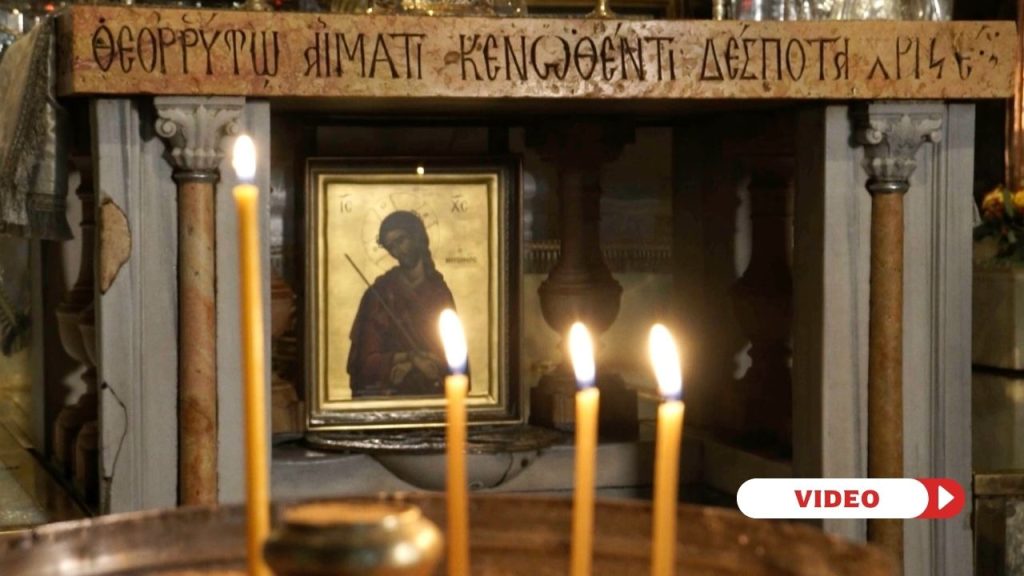
“The concept of incarnation becomes something more concrete, less abstract, less theoretical,” he says. “And to pray at the Holy Sepulchre and the grotto of Nativity, the Grotto of Nazareth and at this beautiful place, the Sea of Galilee… this was something that helped me to give concreteness to the Scripture and also in a way, to live the sacraments, especially the Eucharist, in a different way with the time.”
For him, the Holy Land offers a unique way of encountering Christ — not only intellectually, but experientially.
“The Holy Land is a fifth gospel. I call it also a kind of eighth sacrament, because it helps you to make experience, concrete experience of encounter with Jesus, the humanity of Jesus.”
He adds that such an encounter requires preparation and openness:
“So to prepare yourself to read the passage of the gospel that you are going visit on the place. It is a moment where you focus on your relationship with Jesus and where you also understand how far you are from Jesus. So it’s a pilgrimage, it should also include repentance, confession, and a new beginning.”
A Small but Faithful Christian Presence
Despite being the birthplace of Christianity, Christians today form only a small minority in the Holy Land.
Cardinal Pizzaballa acknowledges the challenges, but he does not see minority status as a weakness.
“Well, first of all, the fact that we are a small number, a numerical minority shouldn’t be considered a drama. The strength of the Christians here is the testimony, the witness. If you have power, it is much more difficult to give witness to the authentic faith, Christian faith and the gospel.”
At the same time, he is candid about the growing difficulties facing Christian communities across the region.
“The life of the Christians here is becoming day after day, much more complicated. We are spread all over the country, from Israel to Gaza, in Palestine, West Bank and Jerusalem, of course. And the challenges are connected also with the political situation, which is very problematic… the political instability – to use beautiful [euphemistic] words – is a disaster.”
Hope in the Midst of Conflict
In a land marked by tension and violence, hope can seem fragile. Yet for Cardinal Pizzaballa, Christian hope does not come from circumstances, but from Christ.
“The cross is part of the life of everyone. Hope is not coming from inside. This is the Christian way to see hope,” he says. “If you look for hope within yourself, you don’t find it… The Christian hope is coming from outside. It’s Jesus. The resurrected Jesus is our hope.”
Even in the most difficult situations, he sees signs of this hope in the lives of those who continue to serve others.
“When you see people committed to give their life for others… despite everything, they are ready to put their life at risk in order to do something for the others, out of love for the others… these are those that understood the meaning of Easter: Giving the life out of love.”
And it is precisely there, he says — in acts of sacrifice and love — that hope takes root.
“And this is what I find everywhere in Gaza, everywhere in the communities, in our communities. And this is the source of our hope.”
Adapted by Jacob Stein. Produced by Alexey Gotovskiy; Special thanks & Credits to Nativity Pilgrimage and Khaled Jacoub.
Source: https://ewtnvatican.com/articles/christians-in-the-holy-land-war-and-faith